Bush Twins Oops They Did It Again Gamps Bush

Iassume the Undercover Service agents volition arrive first, checking out everyone in sight. But suddenly the door opens, and in she comes, all alone, dressed casually in an inexpensive greyness dress with a matching cotton sweater, her sandy-blond hair held back with a rubber band.
"Then is this okay? Mexican food?" asks Jenna Bush. "I figured it might make you lot feel more at home."
It'due south a mild July evening in Washington, D.C., and Jenna has agreed to meet me for dinner at the upscale Oyamel Cocina restaurant, between the Capitol and the White House, where Jenna is, as she likes to say, "living with the folks." When I ask her why her Secret Service detail is not with her, she shrugs and says, "I made them drib me off at the corner. I don't want to cause a scene."
At 25, she is a striking, slim immature adult female, her artillery and legs perfectly toned thanks to daily half dozen a.1000. workouts at the White House gym or a wellness social club she frequents. She is likewise unmistakably her father's daughter, with the same brown eyes, the same good-natured grin that slides sideways across her face, and, aye, the same saucy personality, full of sardonic asides.
"Oh, past the way, Dad was going to phone call and say hi, but and so the king of Hashemite kingdom of jordan called," Jenna tells me. "Sorry yous got bumped."
"What do y'all think your dad's doing right now?"
"Riding his bike effectually the White Firm backyard. He'south a maniac on that wheel."
"And your mom?"
"She's probably in the sitting room on the 2nd floor, reading. We got the new TEXAS MONTHLY, by the way. I saw you had an article in there. All I have to say is, I hope you write a better one most me."
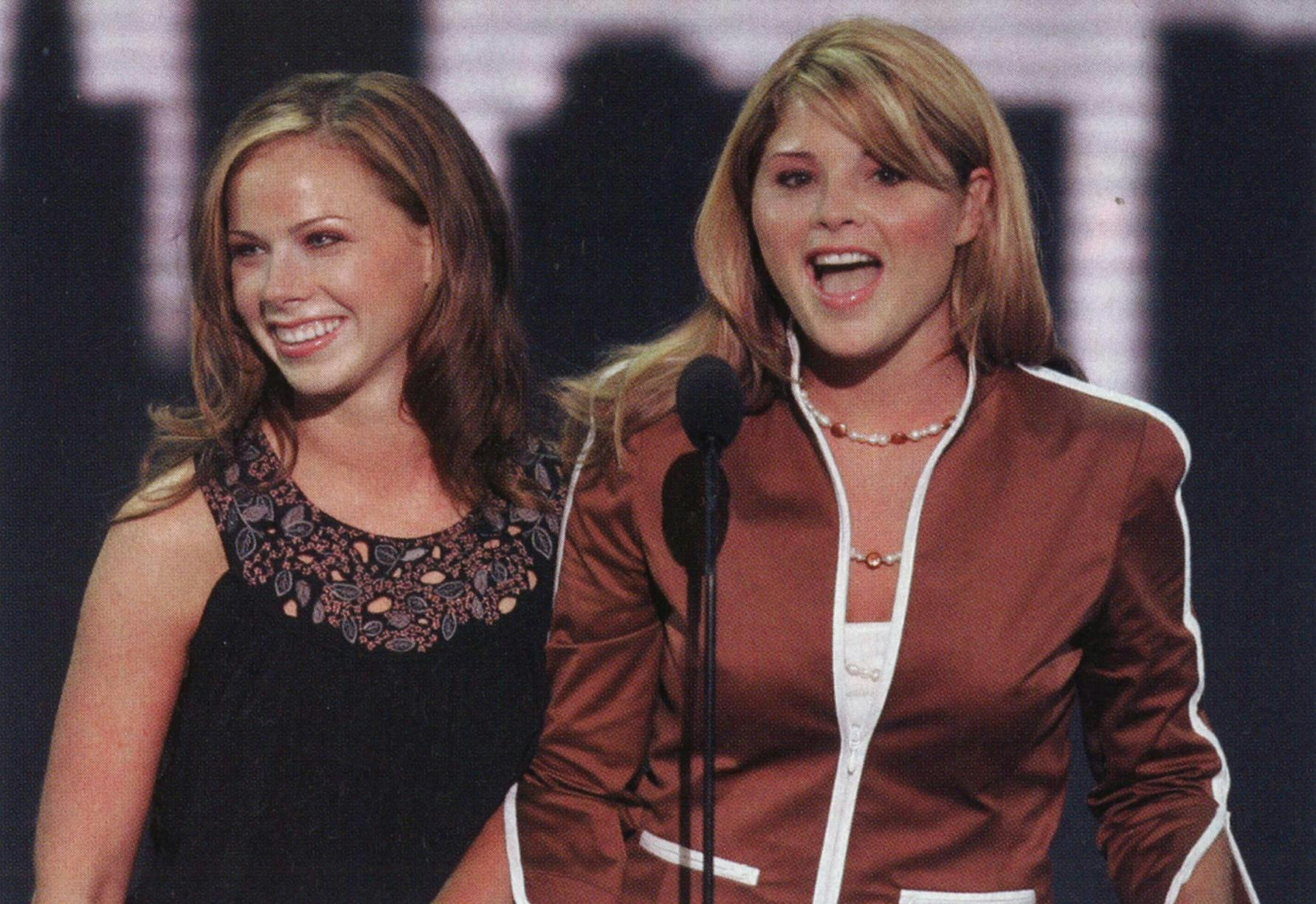
She chuckles, and a few diners at nearby tables glance her way. Over at the bar, a couple of young men in suits openly gape at her. Although Jenna has lived in Washington only since graduating from college in 2004, she is one of the urban center's 18-carat celebrities. Her twin sister, Barbara, who lives in New York City, is rarely recognized when she goes out in Manhattan. But being a Bush in Washington is a far different feel: Jenna cannot evidence up anywhere without later on seeing her name in a gossip column or on some snarky web log. Just a week before our dinner, in that location had been an particular in the Celeb Sightings section of the Washington Mail service's Names and Faces cavalcade claiming that Jenna had been spotted at a trendy eatery eating foie gras. The news had set off a small controversy, prompting the president of People for the Upstanding Handling of Animals, Ingrid Newkirk, to fax a letter to Jenna at the White Firm, angrily describing the grisly weather ducks must suffer at duck farms. "Information technology's simply united nations-American," Newkirk wrote. "Volition you commit to never eating foie gras again?"
"Foie gras," says Jenna with another chuckle, shaking her head back and along in mock exasperation, just as her father does when reporters ask him what he thinks are stupid questions. "Where did they come up with that? The only meat I eat is fish."
A waiter appears, and Jenna orders a pocket-size dish of ceviche, a pocket-sized dish of beans, guacamole, and a glass of water with no water ice.
"No potable?" asks the waiter.
"No drink," Jenna firmly says, shooting me an tickled glance. "I'one thousand making it an early evening. Really, these days, I almost always make it an early evening. I like to exist in bed reading or watching a picture show past 9 o'clock, and I'm asleep by ten or ten-thirty."
She notices the skeptical look on my confront and shakes her caput again. "People alter, you lot know."
Boy, do they. Wink dorsum to December 2000, not long afterwards her father eked out a victory in the presidential election. There, in the National Enquirer, was a virtually total-page photo of Jenna, so a nineteen-twelvemonth-old freshman at the University of Texas at Austin. She had a cigarette in her hand and was laughing hysterically as she crashed to the flooring atop a female friend at a party.
"Go Ready, America!" blared the Enquirer'due south headline. "Here Comes George W.'s Wild Daughter."
Then, a few months later, Jenna was cited for underage drinking at a bar on Austin's Sixth Street. Within weeks she was cited a second fourth dimension for underage drinking, this time with Barbara, who had merely completed her freshman year at Yale. At present the mainstream press paid attention, and suddenly Jenna and Barbara institute themselves heralded, and derided, from coast to coast as America'due south new political party girls.
Jenna got the brunt of it. Jay Leno joked that her Hole-and-corner Service nickname was Roger Clinton, that she was learning to play a new musical musical instrument: the Breathalyzer. High-brow op-ed columnists piled on, purporting to psychoanalyze Jenna, arguing that her antics were acts of adolescent rebellion or signs of deeper emotional problems. Ane went so far as to propose that Jenna had the same kind of drinking trouble that had affected her father when he was younger.
Well, America, get fix once again: Here comes George W. Bush'southward mild daughter. Yous can however find her having the occasional drink with her friends at a happening nightspot in Georgetown or hanging out at the Iota Guild and Cafe, in Arlington, Virginia, where she likes to listen to alive music (especially by Larry McMurtry'south son, James), only she'due south begun to behave like, of all things, an adult. As nearly everyone knows by now, Washington's most eligible bachelorette recently took herself off the market: In Baronial the White House announced that Jenna would be marrying Henry Hager, the son of a former lieutenant governor of Virginia.
Even more surprising, she's now a big-time writer—and an activist. Jenna, who since 2005 has been teaching at an simple school in a low-income D.C. neighborhood, has written a book that she says is meant to be "a phone call to activity" to young Americans. Ana's Story: A Journey of Hope is almost an HIV-positive seventeen-twelvemonth-erstwhile single mother whom Jenna met in 2006 when she took nine months off to work as an intern with the Latin American segmentation of UNICEF, the United nations' program for children in demand. Near of the book is a straightforward narrative about Ana'south struggle to find happiness while battling her affliction, too every bit severe corruption, fail, and poverty. Only in the terminal chapters, Jenna not only offers teenagers detailed advice virtually how to avoid contracting HIV, she tells them what to do if they're physically or sexually abused. She exhorts them to assist other kids in their own communities who take been neglected or mistreated, and she encourages them to spend their summer vacations working with groups like UNICEF or Habitat for Humanity.
The book'south publisher, HarperCollins, was and so impressed with Ana'due south Story that it reportedly ordered a beginning printing of a whopping 500,000 copies. Past the fourth dimension yous read this, Jenna will be in the eye of a ix-week, cross-land promotional tour. Most of her time on the road will be spent visiting schools, where she says she wants "to increment kids' awareness of other immature people effectually the world—to assistance them learn near the challenges they face and how they can triumph over arduousness." But she'll likewise accept sat down with a few big-brand interviewers, including Diane Sawyer, of ABC News, and Larry Male monarch, of CNN.
Jenna insists there'south no hidden meaning to her emergence equally an private in her own right—"I hope people call back of me as someone who loves kids and who wants to make a difference," she says—only the media are dorsum on the psychoanalysis shell. It has not gone unnoticed, for instance, that Jenna is doing exactly what her father once did: moving by her "younger, wilder" days, to utilize his own infamous description, to find purpose in her life—and, by the way, doing it at 25 rather than twoscore, which was when her father quit drinking and righted himself.
The lit crits, meanwhile, accept come later her in total force. Some have put out the word that Ana's Story reads more than like fiction than nonfiction (Gawker.com: "Is Jenna Bush-league the New James Frey?"), while others have implied that Jenna, a first-time author, wasn't competent enough to do the book without a ghostwriter (Entertainment Weekly: "The book is skilful. Peradventure too proficient. We take a hard time imagining that she wrote it herself").
Equally for the appointment, some Bush haters claim it'southward zip more than a crass political ploy, with the anniversary existence rushed and then that the president can become some positive press before his term expires. Ane catty Washington blog, Wonkette.com, speculated that the only reason Jenna is getting married is because she'due south pregnant, and it has published pictures of her at odd angles, supposedly showing her stomach pooching out. The peacenik left, meanwhile, maintains that no matter the reason for the wedding, Jenna's new husband should immediately be sent to Iraq so that the Bushes can finally understand firsthand the real touch of the war on American families.
Predictably, Jenna has also resurfaced every bit a favorite punch line of the late-nighttime comedians. Conan O'Brien: "Jenna's written her book for children, which is a good thing. At present her dad will exist able to read it also." David Letterman: "It'southward going to be an expensive hymeneals. I guess it's no surprise the three-billion-dollar contract is going to Halliburton." Jay Leno: "Jenna announced her engagement 2 weeks ago, although President Bush knew about it over a month agone from some wiretaps."
"I promise people will put politics aside and see the bigger movie," Jenna says. "But I have to tell you, sometimes I say to myself, 'A year and a half and counting.'"
"A year and a half?" I ask, and then it hits me: On this night, that is exactly the amount of time the Bushes have until they go out the White Firm and return to private life. That is too the amount of time before Jenna and her sister are no longer presidential daughters.
"A year and a half," Jenna says, giving me another grin. "Then nosotros'll get to spotter people make up things almost someone else'southward kids. Now that would be a change, wouldn't information technology?"
Information technology's no secret that presidential children pb atypical lives during the years their fathers are in function. Information technology's certainly no surreptitious to Jenna'south own begetter. When George Herbert Walker Bush was elected president, in 1988, George Westward. asked a family adviser, Douglas Wead, to research what happens to presidential children. "He was going through one of his rare moments of existential cocky-reflection," Wead recalls, "and he said, 'And then what happens to me at present?'"
Wead produced a 44-page study noting that some presidential children had led exemplary lives: They had written books, founded corporations, headed fine educational institutions, and won political office themselves. Only many more were burdened with higher-than-average rates of divorce and alcoholism. Some seemed bent on cocky-destruction, haunted by their inability to inhabit their own identities. The stories of most presidential children, Wead ended, were "overwhelmingly nighttime."
At the time, Wead says, Bush "shrugged off the report. He didn't believe in curses. He didn't believe that whatever happened to other presidential children in history had any meaning for him in the nowadays." And sure enough, though Bush seemed to be the archetypal underachieving presidential son, he did find his footing, assembling the group of partners who purchased the Texas Rangers in 1989 and then winning the 1994 race for governor.
Merely in 1998, when he was leading in presidential preference polls for the 2000 election, Bush-league told Wead (and many others) that he probably wasn't going to run for one reason: He didn't desire to ruin his daughters' lives. If he won, he said, they would be thrust into the public eye at the very moment they were entering college. They would have Underground Service agents post-obit them. They would take to bargain with all kinds of stress. Besides, he said, the girls didn't want him to become president. If they got out of line only ane time and the press got wind of it, God help them.
I've always wanted to know just how shut Bush came to calling off his presidential run considering of the girls. Was he genuinely worried that they would turn out to be similar so many of the children mentioned in Wead's report? But I assumed I would not be interviewing him for this story: The president and the first lady have maintained a strict no-annotate policy about the twins, insisting that they deserve their privacy, regardless of their behavior.
Then, on the night afterward my dinner with Jenna, the phone rings in my Washington hotel room. "Hey," says Jenna, "hold on a minute"—and she passes the phone to someone else. Suddenly I hear that familiar voice . . .
"Skipper!" the president says, using the nickname he gave me when I met him during his first gubernatorial entrada. On this very day, the pollsters for the Washington Post and ABC News had reported that 65 percentage of Americans disapprove of Bush'south job functioning, which makes him the second-most-unpopular president in the history of modernistic polling (only behind Richard Yard. Nixon's 66 percent disapproval rating). What'south more than, the front end pages of various newspapers are full of stories about members of Congress calling for the resignations of various Bush-league staffers and attacking Bush's treatment of the war. Some on the fringe are fifty-fifty invoking the i-word: "impeachment." Yet perhaps because he knows I'm writing virtually Jenna, he is completely ebullient. He asks how my wife and daughter are doing—amazingly, he however remembers their names, even though he hasn't seen them since 1996—and, only like Jenna, he jokes about my writing. "What? You haven't written a book all the same?" he chortles.
When I reply that Jenna is already a far more accomplished writer than he is, that her book is amend written than his campaign autobiography, A Charge to Keep, he says, "You can arraign Karen [Hughes, Bush'southward longtime adviser, now an Undersecretary of State] for that. She wrote it."
I ask him if he's nervous about ane of his daughters finally stepping into the spotlight. (Barbara, who works in the educational programming division of the Cooper-Hewitt design museum, in New York City, has told me she is happy remaining as anonymous equally she can.)
"Yeah, a little," he says. "I was worried about Jenna being exposed."
"Exposed to what?"
"Reporters similar you," he cheerfully snaps. "But actually, I cannot tell yous how proud I am of her for going out on her ain and writing this volume. I'm bursting with pride over both Jenna and Barbara. They are very capable, intelligent, and engaging immature women, and they are accomplishing a corking bargain with their lives."
And then he says, "Okay, that's enough for your story. I don't desire this to be about me."
I try to get in a question about his anxieties regarding the girls when he was first running for president, simply he'due south already moved on. "I've got to go consume," he says. "Mrs. Bush is yelling at me, and you know what happens when she yells at me. All right, dude, I've got to go."

Even as a child growing up in Dallas, Jenna was known every bit the rowdy twin. My stepdaughter went to the same elementary schoolhouse that she and Barbara did, and when I ask her about those days, she says Barbara was bookish and Jenna was ever talking up a tempest as she walked the hallways between classes. Barbara agrees. "Jenna was definitely louder and funnier and more approachable," she told me, "and I was similar my female parent: quieter, more than reserved."
At Austin High School, which the twins attended during their begetter'due south gubernatorial years, Jenna was wildly popular. "She was this keen character, actually funny, like a stage comedian, and a scrap of a klutz who'd autumn out of her chair," recalls 1 of her friends. She was constantly dating—one year she invited iii guys she had gone out with to the same Christmas political party at the Governor's Mansion (including Blake Gottesman, for a time one of the president's trusted aides)—and she did her share of partying. According to the Houston Relate, Jenna was involved in what the newspaper described as "a Texas Alcoholic Beverage Commission incident" at the age of sixteen, the outset of three such underage incidents. During Bush's inauguration party to celebrate his reelection as governor in 1998, Jenna and Barbara slipped abroad to go out with their friends, and their ticked-off father stayed up until two-30 in the morn calling various parents and trying to find them.
Jenna is deeply nostalgic nearly her Austin days. "It was a fourth dimension when we could all walk as a family from the Governor'southward Mansion to Manuel'due south [a Mexican eatery on Congress Avenue] and no one noticed us—or if they did detect us, they didn't intendance," she says. The Bushes had dinner together almost every dark, and the conversations, according to Jenna, were gratis-flowing. She didn't hesitate to challenge her dad: During 1 dinner, she plunked her fork on her plate, told him that the death sentence was wrong, and argued that the convicted killer Karla Faye Tucker should not be executed. (Her father listened respectfully, she says, merely told her he would not exist granting Tucker a reprieve.)
At the terminate of their senior year of high school, the more than fashionable Barbara was voted "virtually likely to appear in Vogue" by her classmates, while Jenna was voted "most likely to trip at the prom." By then, Bush was running for president, and Jenna admits she and Barbara were not happy about information technology. "We were really independent kids, and the thought of Surreptitious Service agents following u.s. all the time was terrifying," she says. "Just when it came right downwards to it, we idea, 'He should run because he would be a great president.' How unbelievably selfish would it take been for us to say, 'Please, Daddy, don't do it considering we're nineteen and information technology might affect our life negatively.'"
The Bushes were so determined for the girls to pb normal lives that they kept them out of sight during the entire entrada and asked the Hole-and-corner Service non to hover over them while they attended classes or hung out with their friends. Then, after the election, the president made it clear to the press corps that in that location would exist hell to pay if he discovered that reporters were prying into Jenna's or Barbara'south life.
As a result, except for the Enquirer story, there was goose egg written virtually the twins—until February 2001, simply ane month afterwards Inauguration Day, when it was learned that Jenna had persuaded her Cloak-and-dagger Service detail to drive to the Tarrant Canton jail in Fort Worth to pick up one of her male friends who had been busted for underage drinking during a fraternity party at Texas Christian University. The story was funny. You had to admire her chutzpah. And information technology was hard not to laugh again, a couple months subsequently, when the news broke that Jenna'south agents had allowed her and a friend to go into Cheers Shot Bar, on Sixth Street in Austin, even though they were both under the legal drinking age. The agents were sitting in a auto exterior the bar when, to their dismay, they saw a couple of undercover Austin cops cite Jenna and her friend for that dreaded teenage offense: MIP (modest in possession of alcohol).
Underage drinking is, inevitably, a fact of life in a higher town like Austin. Some faculty at UT guess that 90 percent of the school'southward 49,000 students drink alcohol. The year Jenna got her MIP, there were some five hundred alcohol-related citations issued in Austin to people nether the age of 21. Even so, none of them was the child of the president of the U.s.a.. Everyone couldn't assist but wonder why Jenna would take a risk like that, knowing what kind of publicity would come up her way if she got busted. "To be honest with you, I didn't feel that guilty nigh information technology," she says. "I was adamant that I was non going to stay in my dorm room and do nothing later my dad had been elected. I wanted to do what other people in college do and have experiences."
But then, in late May 2001, but a scant two weeks after Jenna went to court to plead no competition to the get-go MIP—for her court appearance, she wore a black tank peak, pink capri pants, sandals, and a toe ring—she, Barbara, and a friend showed up at Chuy'southward on Barton Springs Road, in Austin, a eatery that the Washington Post later described as "a joint known for mediocre food and killer margaritas." The waitress asked everyone at the table for identification. And here'south where Jenna made her big error. Although she surely had to have known that she was UT's most famous female person student, she pulled out a fake ID. Subsequently recognizing her, the manager, Mia Lawrence, told her she would non exist served. When Lawrence realized Barbara was as well at the tabular array, she called 911 to say that there were minors on the bounds attempting to purchase alcohol.
Lawrence could easily have said to Jenna and Barbara, "Girls, become out, you can't drink hither," and that would have been that. If you've been to Chuy's, you know that college kids trying to buy drinks are non exactly an endangered species. How ofttimes does the manager phone call 911? Clearly, Lawrence wanted to narc the twins out. (According to the police written report, she told an officer, "I want them to get into large trouble," a argument that led to much speculation amid Austin Republicans that Lawrence was a Democrat.) And so, in a scene direct out of a Hollywood comedy, the cops arrived, and Jenna's and Barbara's Surreptitious Service agents, no doubt imagining the end of their careers, sped out of their cars hoping to bust up the bust. 1 agent promised the cops that the twins would go out. But after several calls between Austin police force officers, commanders, and fifty-fifty the chief, the decision was fabricated to go ahead with the citations.
The media firestorm was almost instantaneous. Within days, the Austin Police Section had received more than four hundred phone calls from reporters. The tabloids, of grade, had a field day (the New York Post'south front-page headline read, "Jenna and Tonic!"), and the late-night comedians nursed the story for months. ("Information technology was a long, tiresome speech," David Letterman said later 1 of President Bush-league's State of the Union addresses. "Halfway through, Ted Kennedy sent drinks over to the Bush twins.") On the Fox News Channel, Nib O'Reilly insisted the story was worthy "because [teenage drinking] is a very difficult problem that touches almost every American home." Meanwhile, political reporters suggested that the twins' antics were distracting the president from more-pressing matters.
Historians rapidly thought back to Ulysses Grant'southward teenage girl, Nellie—"probably the most bonny of all the immature women who have always lived in the White House," i wrote—who at 16 was cavorting with so many Washington men that her parents sent her on a long trip away. (It didn't work. She met an alcoholic con human in England and married him.) And to Teddy Roosevelt's flamboyant daughter Alice, who smoked cigarettes in public—she in one case smoked on the rooftop of the White House to defy her father—and flirted shamelessly with any number of men, single and married. Alice, described past one paper equally "Washington's other monument," was such a alive wire that President Roosevelt once said, "I can either run the country or attend to Alice, just I cannot possibly do both."
Luckily for Nellie and Alice, there were no blogs, cell phone cameras, or paparazzi back then. No presidential kid, non even Chelsea Clinton, has had to contend with the peculiar mix and relentless proliferation of media outlets that the Bush girls face daily. Indeed, after the Chuy'southward incident, dozens of Spider web sites promised up-to-the-infinitesimal coverage of their every move. ("My favorite retentivity of Jenna Bush," wrote one Internet sophisticate, "is of her belching actually loudly a few times in a row and and then airsickness in the club bathroom.")
Although the president refused to comment on the attention his twins were getting, an angry Laura Bush did tell CNN, "If nosotros never saw their pictures in the paper once again, we'd exist a lot happier." But she wouldn't say anything more. (And still won't. The first lady refused my requests for interviews, probably sensing, correctly, that the commencement thing I'd inquire her is "What in the world did you say to your girls after that Chuy's deal?")
Today, Jenna is hesitant to rehash the episode, though she says she spoke to her male parent "right away." "Believe me, right away. I felt terrible because I had acquired problems for my parents. That's not to say I didn't feel I had fabricated a mistake. But I wasn't that devastated. I was a 19-year-old girl in college. A lot of my friends got MIPs. What actually bothers me is that people still judge me on ane thing that happened vii years ago."
In fact, it was practically impossible for both Jenna and Barbara to milk shake off their margarita-swilling reputations. As the years passed, many people regarded them as frivolous young women with no existent ambitions. Later on they turned 21, stories regularly appeared in the glossies, the tabloids, and the gossip columns about their comings and goings at chic nightclubs, Hollywood parties, and, at one point, a karaoke bar, where Jenna supposedly belted out "Sexual practice Auto," by James Brown. One report had her hanging out with Sean "P. Diddy" Combs in Saint-Tropez. The immature actor Ashton Kutcher told Rolling Stone that afterward meeting Jenna and Barbara in Los Angeles, he took them back to his house, where they had drinks, and he later found them upstairs with one of his buddies, who was, in his words, "smoking out the Bush twins on his hookah."
They did seem more comfortable in any setting other than a political one. They never fabricated any public appearances during their father's first term. In 2002, when Jenna flew to Europe with her mother on her outset state visit, she wore corduroy pants with tattered hems and a T-shirt that exposed her midriff—not that people could tell. To avert photographers, she hid behind garment bags held up by White Firm aides.
Such behavior led Ann Gerhart, a author at the Washington Post and the author of The Perfect Married woman, a acknowledged 2004 biography of Laura Bush, to acidly describe the twins every bit having "all of the noblesse but none of the oblige"—pampered bluish bloods who had shown "little interest in any of the pressing problems their generation will inherit nor shown empathy for the struggles facing their female parent and male parent." President and Mrs. Bush-league, Slate columnist Michael Crowley added, were "permissive, laissez-faire parents more interested in shielding their daughters from prying optics than in drumming solid values into them."
Jenna freely admits that she has never cared about politics. "I just wasn't interested, and I'm still not interested," she says. Nor was the obligation of upholding the family'southward expert name—"the Bush legacy," every bit I referred to it—ever impressed upon her. "Legacy?" she asks, with obvious irritation. "The give-and-take bothers me. It'due south not similar my father or my grandparents had some path in mind that they wanted us to follow. They nourished any passions nosotros had without trying to command them. They let us find our ain paths, and to me, that'due south the perfect way to parent."
What rarely got reported was Jenna'south bookish achievements. An English major, she did very well at UT (as did her sister, a humanities major, at Yale—unlike y'all-know-who). "Some people major in English to become away with some easy classes," says UT English language professor and TEXAS MONTHLY writer-at-big Don Graham, who taught Jenna in his Life and Literature of the Southwest course. "But Jenna was serious, someone who genuinely liked to read and had very proficient gustatory modality in the books she chose. She wrote a newspaper for me on Katherine Anne Porter [the Texas-born short-story writer and novelist] that was i of the more memorable I had ever received from a student." Graham says Jenna was besides intellectually curious. He took his course i 24-hour interval to Scholz Garten to meet the Australian novelist Frank Moorhouse, and she immediately began asking him questions well-nigh his career. "She bought him a beer," Graham recalls. "I thought, 'Oh, God, here comes another international incident,' but my wife told me afterward that Jenna had already turned 20-one."
When Jenna graduated, she was planning to move to New York; live with her all-time friend from UT, a photographer named Mia Baxter; and starting time teaching at an elementary schoolhouse. Merely subsequently dreaming that her male parent had lost his bid for reelection, she called Barbara, and the two of them decided, for the first time, to get involved in one of his races. It wasn't heavy lifting: They gave a few interviews, posed in evening dresses for Faddy, and traveled the land in a van, speaking to entrada volunteers and immature Republicans. Even if Jenna didn't like politics, she had a knack for it. "Dad says this is going to be his last campaign," she would say, before adding, "Thank God." She'd tell lots of funny stories about him, including one in which he refused to leave a Texas Rangers game until the last out, fifty-fifty though the temperature was 108 degrees. "He's always supported his team until the very end," she'd say (a rather prophetic comment when you consider his current troubles). Of course, Jenna being Jenna, she playfully stuck her tongue out at reporters one afternoon while driving away from a rally. And, reporters beingness reporters, they fabricated hay of it. A writer for the New York Times suggested that her act of rebellion may have "reminded voters of her father'southward reputation equally a frat prankster, which may non be the image that his entrada wants to rekindle in a time of the war on terror."
Subsequently the ballot, Jenna inverse her heed and decided to alive in Washington. She moved into an flat in Georgetown with three roommates (two of whom she knew from Texas) and took a task as an assistant instructor for $36,000 a year. She asked her parents for, and received, her ain SUV to bulldoze herself back and forth to the Elsie Whitlow Stokes Community Liberty Public Lease School, which is seventeen blocks north of the White House. (Her Secret Service agents follow close behind.) The school has 250 students, 90 pct from low-income homes. Jenna has thrown herself into the task completely, dressing every bit the Cat in the Lid on Dr. Seuss'south birthday, leading an after-school book lodge to help struggling readers, taking her form to the White House at Christmas to see a screening of The Chronicles of Narnia and to play with Barney, one of the president'due south dogs.
"I admit, we were a piddling worried near what was going to happen," says Bobby Caballero, the school's dean of students. "We were worried that we were going to get a lot of public attention, and we didn't know how the kids would react to the president'due south girl being here. So 1 day nosotros had a question-and-answer session with Jenna and the kids. They asked her questions like 'Is your dad rich?' and 'Have you ever ridden in a limo?' And then, when it was all over, they pretty much forgot about who she was."
"Sometimes," says Jenna, "I nevertheless have kids ask me, 'Miss Jenna, what would happen if I Google you?' And I say, 'Oh, please, please, no, don't do that. '"
During one of my days in Washington, I visit Jenna at her schoolhouse, where she's teaching a summer writing workshop to 11 Hispanic and African American fourth- and fifth-graders. She'southward wearing what she tells me later are her "instructor's apparel"—a beige shirt, linen pants, and brown loafers that she bought at Target—and on top of her desk is the big backpack that she uses to bear her books and the salad she buys for lunch each day at Whole Foods.
"All right, guys," she says, belongings upward Journeying to Jo'Burg, a children's book about the life of a South African family unit. "Who tin can tell me why the blackness families are protesting?"
A boy named Gustavo raises his hand. "Because the white people are treating the black people similar . . ." He hesitates before finishing the sentence.
"Like what?" Jenna asks. "You lot tin say it."
"Similar trash?"
"Exactly, Gustavo," Jenna says, nodding her head. "Like trash." She walks to the blackboard and writes the word "segregation." And so she writes "apartheid." "This is what happens whenever white people treat black people, or people of color, similar trash. And whenever in that location is segregation or apartheid, what must we do?"
She writes the word "protest."
"Protest," says one of her students obediently.
"Now," Jenna says, "I want everyone to take out their Freedom Writers' Journals and write a meaningful sentence using the give-and-take 'protestation.'"
I sit back, amazed. Who could accept imagined George Westward. Bush'due south girl teaching inner-metropolis kids something so politically correct—then liberal—as the principles of social justice? Have I stumbled into Jenna Kucinich's form?
"All right," she says a few minutes later. "It'southward time for Journalists' Society. How is everyone doing on their stories for the weekly newspaper?"
After form, I pounce. "You're teaching your kids to be reporters? Have you told your dad yous're out here creating a new generation of journalists?"
"Hey," she says, "journalists practise good things." She pauses and stares at me, pursing her lips. "Well, most journalists, anyhow."

In late June 2006, Amy Argetsinger and Roxanne Roberts, who write the Washington Postal service's popular Reliable Sources gossip column, bankrupt the news that Jenna was taking a leave from education to take an internship in UNICEF's Latin American role. They seemed devastated. Jenna, they wrote, "is skipping the country and bidding a happy adios to the young-Washington social scene she one time ruled. Uh-oh, what practise we practice now?"
Jenna says her decision to piece of work for UNICEF was largely inspired by her sis's experience volunteering for nine months at an AIDS hospital in Due south Africa. (Apparently there was some oblige subsequently all.) Barbara had told Jenna that her time at the hospital was and so life-changing that she sometimes felt she should even so be at that place, finishing the work she had begun. But Jenna likewise wanted to go, she admits, considering she had tired of Washington'due south endless political chatter—and of people wanting to get close to her only because she was a Bush. "I was ready for some anonymity," she says.
Ostensibly, her job was to work out of UNICEF's headquarters in Panama, learn about its work, interview kids in different countries about their particular adversities—AIDS, hunger, child labor—and then write articles for the organization's Web site. And, indeed, in the first few weeks of her internship, she traveled to a drought-stricken surface area of Paraguay and to urban slums in Argentina. Just she could not stop thinking about a teenager she had met along the way. "We were at this coming together for women living with the HIV virus," says Jenna's friend Mia Baxter, who had also signed up for the plan and who lived and worked with Jenna, shooting photos of the children Jenna interviewed. "This teenager stands upward, property her babe, and says in a clear voice, 'We're not dying from HIV. We're living with HIV.' I looked at Jenna. Nosotros both started crying."
Jenna began meeting regularly with the teenage mother—in the volume, her name has been changed to Ana to protect her privacy—and learned how her parents had died of AIDS, how she was sexually abused by a man at her grandmother's house, how she spent many painful years in an orphanage, and how she roughshod in dear with a boy for the beginning time and became significant after a single nighttime of unprotected sexual activity. "She was seventeen, but information technology seemed like she had lived a hundred years," Jenna says. "She was this girl wearing a T-shirt and sparkling earrings, simply she was so much more than of a woman, with a gracefulness that I certainly didn't have at that age."
One day, Jenna walked into the role of Marker Connolly, the senior adviser to the UNICEF regional officer for Latin America and the Caribbean, and said she wanted to write a book nearly the young mother. Information technology was an impulsive determination: Jenna had never written anything other than a few poems and papers in college. "I was encouraging, of course," Connolly recalls, "only I kept thinking, 'What if I read the manuscript and information technology isn't any practiced? How exactly does ane tell the daughter of a president that the book doesn't work?'"
Jenna began doing long interviews with Ana in Spanish and wrote 5 capacity over the course of three weeks. Connolly says that when she showed him what she had done, he was "blown away" past her ability to re-create the life of the immature mother. Over Christmas break, Jenna gave the partial manuscript to her female parent, a sometime teacher and librarian, who promptly circled all the passive verbs. ("Mom," Jenna yelled, "it's a first draft!") Washington lawyer Robert Barnett, who specializes in securing volume deals for Beltway VIPs, took her and the five capacity to meet publishers in New York. The editors at HarperCollins were and so impressed that they offered her a reported $300,000 advance—slap-up for a volume for teens, and groovy because that no one knew (or knows) if a book by a Bush would sell in a country that is, at the moment, anti-Bush. "In my get-go conversation with Jenna, I felt inspired just listening to her talk," says Kate Jackson, the editor in principal of HarperCollins children'south books. "I saw that she was a very gifted writer, a natural talent. She had an innate sense of how to brand the pacing of her book incredibly tight and intense, which is not what you usually run across in a new writer."
When Jenna returned to her internship, she met with Ana at to the lowest degree iv times a week, request dozens of questions and then writing. "24-hour interval and night," says Baxter, "sitting at her desk-bound in front of her laptop, wearing these huge goofy headphones that would block out racket."
"It was pure lunatic writing," Jenna says. "Mia probably thought, 'Oh, we'll go to the embankment on weekends, nosotros'll become hiking, we'll become to a festival,' and I'd say no and I'd write. I got inspired. I got inspired about getting out there and opening kids' optics about someone like Ana and talking with them about how they can assistance change things. I experience similar kids desire to make a departure, merely they don't know how. Or they don't feel empowered. They don't feel they can actually change the earth, and I call back they can."
Although Jenna says she arranged for function of her advance to go to a fund to pay for Ana'due south college educational activity, she initially did not tell Ana who she was. She truly loved her anonymity during those months—"walking upward and downward the streets, not having people do double takes," she says—and she didn't want her fame to get in the way of her relationship with her subject. Merely she couldn't stay anonymous forever. When she met Barbara in Argentine republic for a few days of holiday, the freewheeling local press got ahold of the news, and shortly there were reports that Jenna and Barbara had been seen running nude downward a hotel hallway, that Jenna had fallen in love with a boyfriend in Argentine republic and was bringing him dorsum to Washington to meet her parents, that U.S. diplomatic mission officials had "strongly suggested" that the twins go out the state considering of security concerns. Information technology wasn't long before the U.S. media were repeating the aforementioned stories—"the Paris and Britney of the political world!" the New York Daily News called them—and late-night comedians were on the air with notwithstanding another round of jokes. Jon Stewart: "Only to repeat: Argentine republic, former safe haven for Nazi war criminals, is drawing the line at the Bush twins!"
"Lies, all lies," Jenna tells me with a sigh. "There was no nudity, no running up and down hallways, no getting kicked out of the state—and no new boyfriend."
On that last point, she is peculiarly emphatic. Unbeknownst to most people, Jenna had been in a serious relationship for several years with Henry Hager, who was working in Karl Rove's function when she met him during the 2004 campaign. Described by i columnist as "tall, dark and Republican," Henry was first spotted with Jenna when he escorted her to one of the inaugural balls. He made news again later on complaining that a spin course teacher at a Washington sports social club was making anti-Bush jokes. Still, he'south known to have a sense of humor: One evening he persuaded the Bush-league family unit to watch a video of the black comedian Dave Chappelle impersonating the president.
When I'1000 with Jenna in July, word of the date has not yet leaked. When I inquire her betoken-bare if she's getting married, she says no. When I try to get her to give me some information almost Henry, who is enrolled in graduate business organisation schoolhouse at the University of Virginia, she'southward coy. When I ask, for example, if he'due south the son of a Virginia politician, she says, "I'k non even sure."
But later in the chat, she begins to open upwards, telling me Henry has passed what she says is her dad's "boyfriend test." (He was able to keep upwardly with the president during a mountain cycle ride but, no doubt to the president'southward joy, was unable to get in front of him.) She says that she and Henry took a long camping ground trip together in 2006, driving from her parents' hometown of Midland to Big Bend, where the owner of a bakery in Tall, without knowing who they were, gave them a huge bag of doughnuts and brownies. ("Henry was shocked. He'due south an East Coast male child. He couldn't believe how friendly people were.") From at that place they went to the 1000 Coulee and on to Zion National Park, in Utah. "We hiked and hiked and hiked and read books at night," she says. "On that trip, we reread our favorite books from schoolhouse."
"What did your dad say when you lot told him you lot and your fellow were going on a trip?"
"He said, 'Practise you accept two tents?'"
"I assume that if Henry comes to visit you at the White House, he stays in his own room."
"Oh, yeah." She laughs. "Dad'due south all the same the traditionalist, yous know."

The appointment and place of the wedding have yet to exist disclosed, though another of Laura Bush's biographers, Ronald Kessler, says he has been told it will be held in May at the ranch in Crawford. Meanwhile, Jenna will have her volume bout to finish. She clearly likes being a writer: She'due south signed a contract with HarperCollins to write some other children'due south volume, this one with her mother, nigh a boy who does not like to read. (Presumably he does not abound up to be president.) Although Barbara's personality is more similar the beginning lady's, Jenna and her mom are shut because of their shared involvement in didactics and reading. Jenna, who moved into the White House after her UNICEF internship came to an end last summer, says she and her mom beloved to get into bed and talk about the novels they're reading. A contempo favorite of Jenna's is Girl of Fortune, by Isabel Allende. "Allende'due south bully," she says. "All of the books I read take strong women characters going out and conquering and becoming independent, and they don't care about men."
Jenna sleeps in what she says is "the White House kids' chamber," just downwardly the hall from her parents' room. (John F. Kennedy Jr., LBJ's daughters, and Chelsea Clinton all slept there.) When I inquire her what information technology'south like to alive in the White Firm, she gives me the kind of throwaway reply that's most worth a story in itself: "I feel like it's filled with millions of ghosts. I get scared at that place sometimes. I'm not kidding. I have heard ghosts, I actually take—ghosts singing opera. One night, opera noises came out of my fireplace. When I told my sister, she didn't believe me, only the next week we were up late in that bedroom and we heard 1950'southward pianoforte music. People will call back I'1000 crazy for saying that."
When she'south with her father, she says, they don't talk shop. She doesn't read the papers or sentinel the news because she tin can't deport to hear him criticized. "You know, when you lot really honey somebody, particularly your father, I hateful . . ." She pauses, and her eyes fill with tears. "I see him as a male parent. I come across him every bit the male parent who took united states of america to soccer games. For me, he is a father who is so much fun. So, yeah, it'south hard to see. Just, you know, you have to ignore it."
I ask her if, in the waning days of his administration, the president is truly at ease, equally he seems to be. She gives me a long await. "No," she finally says, "not all the time. He acts like he'south at ease—or tries to human activity like it—simply he's not always." She's looking forrard to January 2009, she adds, so that her parents can return to Texas and can "just relax. They really tin't relax correct now."
Does Jenna plan to render to Texas likewise? While she talks at length about how she misses Austin, she's staying mum about where she and Henry volition end upwardly. Every bit for writing, she says she'due south non sure about that either. But she does say that regardless of what happens, she will keep teaching. "In our order, where popular civilisation rules the pages, no i is interested in somebody who teaches," she says. "Simply it'southward something I love."
She'southward serious. One afternoon before I exit Washington, I bulldoze for the last time past Jenna's school. I see her down the street at a small city park, where the kids are climbing around on a dilapidated playscape. She is just another young teacher, completely anonymous. A couple of downtrodden people sit on a bench, paper bags at their feet. On another bench is an elderly couple, the husband patting the wife'south back. Immature men, apparently with no identify to exist, stand up on a street corner, staring at traffic. No ane looks her way.
I sit in my car across the street, unseen, and watch her for a few minutes. She smiles at her kids equally they run back and forth, then starts laughing at something ane of them says to her. Finally I hear her shout, "Come on, guys! Recess is over!" They line up and head back to school, Jenna leading the way. As they walk through the front end door, she's still smiling.
Source: https://www.texasmonthly.com/articles/girl-gone-mild/
0 Response to "Bush Twins Oops They Did It Again Gamps Bush"
Post a Comment