Baby Blue Gray Outer Gemstone Baby Blue Gray Outer Geode
Home » Articles » Geodes
Geodes
On the outside they look ordinary, but inside they're extraordinary!
Commodity by: , PhD, RPG
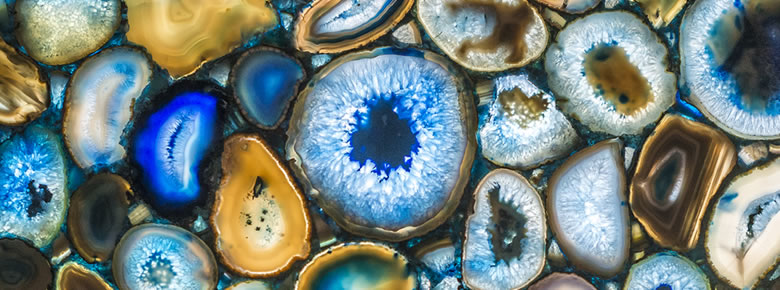
Geode wall panel: A portion of a large backlit wall panel made using thin translucent slices from many types of geodes instead of stained glass. The blue colour in many of the geodes was produced with dye. Image copyright iStockphoto / Klod.
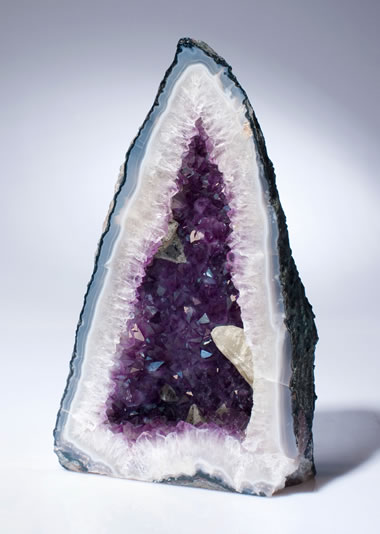
Amethyst cathedral geode: A very high quality amethyst cathedral geode with a natural artistic shape and richly colored amethyst. It also has a dogtooth calcite crystal grown inwards from the lower right wall. Image copyright iStockphoto / simarts.
What Are Geodes?
Geodes are spherical to subspherical rock structures with an internal crenel lined with mineral materials. They have a durable outer wall that is more resistant to weathering than the surrounding bedrock. This allows the geode to survive intact when the surrounding boulder weathers abroad. The mineral lining the cavity is oft a scintillating druse of tiny quartz crystals underlain past multiple bands of translucent gray and white agate. Many are lined with more spectacular treasures.
Rich purple amethyst, perfect white calcite crystals, and colorful banded agate are other common linings. Rare geodes can be filled with beautiful bluish gem silica, pinkish rhodochrosite, spectacular opal with brilliant play-of-color or other rare materials. Geodes range in size from under ane centimeter to several meters in length. From the outside almost geodes look like mutual rocks, but when they are opened the sight tin be breathtaking.
The Public'due south Beloved Matter With Geodes
Most geologists enjoy geodes. However, the general public has a love affair with them. They are delighted and amazed that an uninteresting rock tin can contain a beautiful cluster of gemmy crystals, or a colorful lining of banded agate, or both of those in the same crenel. Broken open, or sawn and polished, people who accept never taken a geology form buy thousands of tons of geodes each yr. They buy them because they savor them. They dear tiny geodes every bit jewelry, sawn and polished geodes as bookends, and spectacular amethyst geodes as items of home or function decor.
In several parts of the world, geode localities take spawned profitable industries that collect them, ready them for market, and ship them to destinations where they are purchased every bit items of science, natural art and enjoyment. Brazil, Uruguay, Mexico, and Namibia are four examples of countries where geodes have become a local manufacture.
Geodes sell speedily at precious stone and mineral shows, scientific discipline museums, rock shops, art galleries and shops that characteristic international or natural gifts. When geode-opening demonstrations are given at rock and mineral shows, they always draw a crowd -- and that crowd usually produces enthusiastic cheers and gasps when a dainty geode is opened. There is something special about a beautiful treasure hiding in a stone that looks absolutely ordinary from the outside.
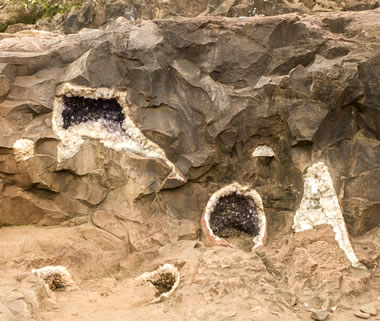
Geodes in basalt: An outcrop of a basalt flow exposing several open up amethyst geodes. This photo illustrates how geodes can occur in large numbers inside a single rock unit of measurement. Image copyright iStockphoto / yio.
Geologic Occurrence and Formation
Geodes are not institute randomly here and in that location. Instead they are normally found in large numbers in areas where the rocks have formed in a special geochemical environment. Most geodes localities are in A) stratified volcanic deposits such as basalts and tuffs; or B) stratified sedimentary carbonate deposits such as limestones and dolomites. A diversity of other environments yield a small number of geodes.
Geodes form in many different ways, and there are a number of valid theories about their formation. The intent of this commodity is not to provide a unmarried or a comprehensive coverage of the many ways that geodes might course.
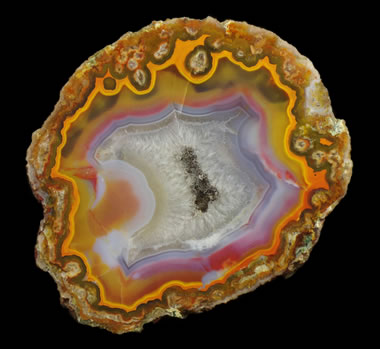
The Story in the Stone: A spectacular sawn and polished geode specimen with multiple layers of colorful agate and a crystal-filled central cavity. Each colored band represents an episode of agate formation and a alter in the composition of the groundwater that delivered mineral textile into the geode. Image copyright iStockphoto / WojciechMT.
Volcanic Geodes
The most widely known and sought-afterward geodes are those that formed in areas of volcanic activeness. Voids in basaltic lava flows oftentimes are infilled with agate, quartz, opal and other material delivered by hydrothermal h2o or groundwater. Some voids are spaces occupied past gases that failed to escape the lava flow before its surface crusted over.
Where does all of the gas come from? Some magmas contain a lot of dissolved gas. They tin can be several percent dissolved gas on the ground of weight. (Call back well-nigh that - several percentage gas past weight!) When these magmas ascend to the surface, the gas expands in proportion to the pressure reduction. When the magma erupts as a lava menstruum, so much gas is released that not all of it is able to escape. Some of that gas can be trapped in the lava to produce a large crenel when the lava solidifies.
Other voids in solidified lava flows were produced as liquid lava flowed out after the menses was but partially solidified. These small-scale "lava tubes" produce some of the largest and longest geodes. Many cathedral geodes are branches of these lava tubes that later infilled with mineral material. Many of them have the geometry of long tree branches, beingness nearly a meter in bore and many meters in length.
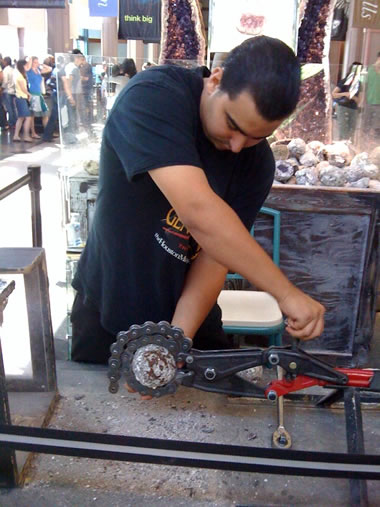
Breaking a Geode: An exhibitor at a gem and mineral bear witness preparing to break a geode. The device used for breaking geodes looks like a long-handled bolt cutter. Even so, the pair of blades used to shear the bolt is replaced by a chain that is tightened around the geode until it breaks cleanly in half. Geode-cutting demonstrations usually concenter a cheering crowd at gem and mineral shows. Image by ilovebutter, used here under a Artistic Commons License.
Sedimentary Geodes
Geodes in sedimentary rocks are unremarkably found in limestones, dolomites, and calcareous shale. In these deposits a gas-filled void tin can serve as the opening for geode formation. Shells, tree branches, roots and other organic materials ofttimes decay away to go out a void for the germination of mineral materials. These cavities can be filled with quartz, opal, agate or carbonate minerals. They are generally smaller than the geodes formed in volcanic rocks.
Geodes are most easily collected when their host rocks take weathered away. This tin can occur because basalt, limestones, dolomites, and shales conditions much more readily and chop-chop than the quartz and chalcedony that typically class the outer layer of a geode. The host rock weathers away and the geodes are left on the surface, washed into a stream, or stranded in a remainder soil. In these situations the geodes are hands found and nerveless. Some geodes are produced by mining the host rock, but that method is hard, costly, and oftentimes amercement the geode.
Naming Geodes
Geodes are given a variety of names. The word "geode" is ofttimes preceded by the name of the mineral material which has filled the geode. "Agate geode" and "amethyst geode" are examples. The give-and-take "geode" might also be preceded by a geographic or stratigraphic name. "Keokuk geode" and "Brazilian geode" are examples.
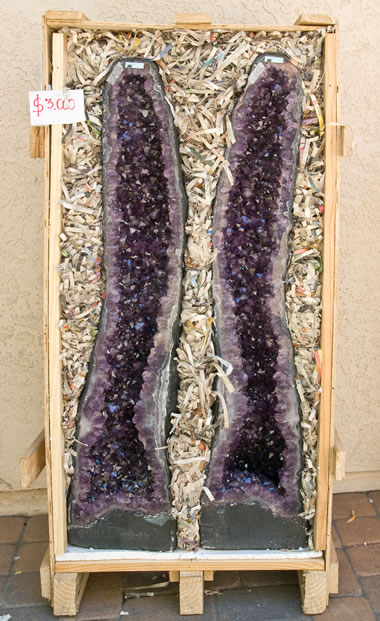
Geodes ready for shipment: Geodes from Brazil and other collecting localities are advisedly crated to preclude damage during shipment. This photograph shows a matched pair of cathedral geodes which are 2 halves of the same cavity. They take been given bases of heavy concrete that will enable them to be used equally items of decor in a home or office. Image copyright iStockphoto / VYG.
Commercialization of Geodes
An unopened geode has the appearance of an uninteresting rock. They become much more than interesting when they are opened and their internal crystals and agate bands become visible. And fifty-fifty though every crystal-lined geode is a wonder of nature, in that location are many things that tin can be washed to brand it into a more than marketable product every bit well as enhance its value.
Museum-Quality Geodes
But, before we go any further, we want anyone who finds a really overnice geode to know that museum-quality geodes are sold in the collector market place for prices that will astound the average person. The Arkenstone, a business concern that specializes in museum-quality mineral specimens, usually has a few squeamish geodes for sale. At the fourth dimension this article was existence written, they were selling rare-mineral lined geodes featuring volkovskite, millerite, thomsonite, and shattuckite for four- and v-digit prices. You lot can come across some of their inventory here.
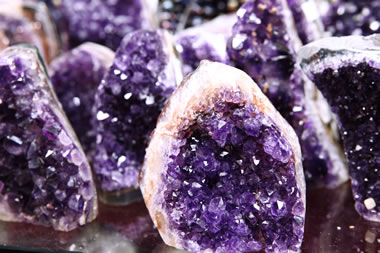
Amethyst geode sections: Small sections of amethyst geodes offered for sale in a tourist shop. Image copyright iStockphoto / danishkhan.
Utilitarian Geode Products
Large agate geodes are often cutting into blocky pieces with a flat base of operations to make beautiful bookends, desk sets, clock faces or paperweights. Those with gray, white, or other less-interesting agate colors are often dyed brilliant blue, green, majestic, red or other colors and then face up polished to brand them more appealing. These treatments make the bookends sell faster and heighten their value beyond what would be paid for the less-interesting grayness color.
Geodes equally Items of Decor
Large amethyst-lined geodes are frequently expertly cut to display their internal amethyst crystals. They are and so sawn and fitted with a weighted base to enable them to be used as an item of home or part decor.
Agate-lined sections of lava tube geodes accept frequently been used to make "cathedral geodes" that are several feet high. These are cut in a way that nicely exposes the amethyst-lined bedroom, they are and so sawn to produce a flat base, which is filled with metal-weighted concrete to enable the geode to stand upright, the edges of the cavity are sanded for dainty appearance, and the unabridged exterior is painted to hibernate the scrapes and scuffs that occurred during collection and transportation. Many of these large geodes sell for thousands of dollars each.
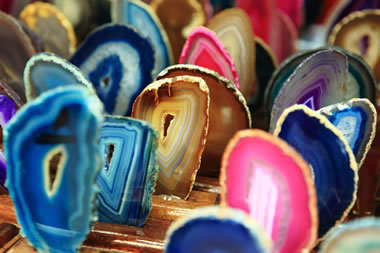
Dyed Geode Slices: These dyed geode slices take been mounted in wooden bases for display. Image copyright iStockphoto / danishkhan.
Geode Novelties
Small geodes are often sliced and polished. Especially dainty slices might be displayed "equally is" in specially-fabricated frames or stands. Some have their translucent beauty displayed in stained-glass panels or windows like the example photograph shown at the superlative of this folio. Less spectacular specimens might be dyed and used to brand current of air chimes, coasters, or decorative magnets. Modest sections of geodes with attractive and colorful crystals are oftentimes sawn into small pieces that volition stand upright or into slabs that are used as display items.
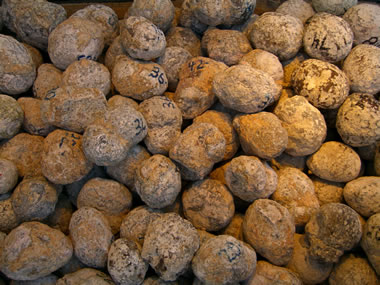
Small Geodes: Pocket-size geodes like these are often sold in novelty and science stores to people who want to have the experience of opening a geode themselves. They want to be the showtime human to meet the treasure within. Prototype copyright iStockphoto / leopardhead.
Break-Open-A-Geode Kits
Small, thin-walled geodes are often sold in kits by department, didactics, scientific discipline, tourist and novelty stores. The vendor production descriptions encourage teachers, parents and students to buy the kits and interruption the geodes open up with a hammer. These geode kits are extremely popular. If you do a Google search for "geode kit" you will find them offered online past dozens of different vendors.
If you are tempted to buy one of these kits, be sure to read the reviews considering quality varies profoundly. It is besides essential to plan for proper safety equipment, considering striking a geode with a hammer tin produce flying rock fragments that can crusade serious injury. You lot will also need a good place to do this activity. Post-obit some of the vendor suggestions of breaking them on a table, or classroom floor, can cause property harm that is costly to repair.
An alternative to purchasing a "pause-open-a-geode kit" every year is to purchase a few specimens of opened geodes and sliced geodes. This tin can be supplemented with looking at geodes on websites using computer projection and videos of professionals opening geodes on YouTube. These avoid the safety, property damage, and clean-up concerns of "breaking geodes." The cost of this approach might relieve coin over time that tin can exist used on other engaging science activities.
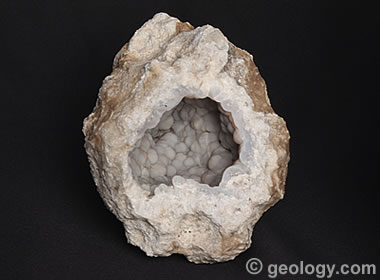
Geode Lined With Botryoidal Chalcedony: This geode was found in the Keokuk Region of Missouri which is famous for its geodes. This specimen is lined with bluish gray chalcedony that exhibits a beautiful botryoidal addiction. Information technology is approximately four inches across.
What? No Crystals?
Everyone expects to find bright, shiny, geometric crystals when they open a geode. Simply, sometimes at that place are other interesting landscapes within. One of the most common finds when geometric crystals are not present is a geode lined with chalcedony, a microcrystalline variety of quartz.
Chalcedony crystals every bit so small-scale that they cannot be seen with the unaided eye. In a geode, a tiny crystal of chalcedony will attach to the wall and it will be coated with a layer of tiny chalcedony crystals all pointing outwards from the seed crystal. Layer after layer is deposited, and the early consequence looks like a small hemisphere attached to the inner surface of the geode. These tiny hemispheres begin to grow into and over 1 another, and the result is a landscape that looks similar a pile of grapes. This hemispherical geometry is a common crystal habit of chalcedony known as botryoidal. An instance of a geode lined with botryoidal chalcedony is shown in the accompanying photograph.
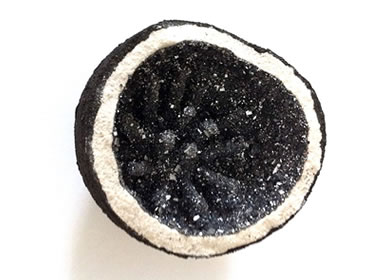
Fake geode: Photo of a galena-lined "geode" made from pottery clay decorated with paint and a covering of fine galena crystals. Purchased in Marrakesh, Kingdom of morocco. Prototype copyright by Guy Courtois, used here nether a Creative Commons License.
Fake Geodes
As with virtually popular or valuable objects, fake "geodes" have been manufactured by people and offered for sale equally naturally-formed objects. If yous are a collector paying serious money for a spectacular geode, you lot need to know enough almost geodes and the mineral materials that occur in them to spot a fake. Skilful gemologists, mineral collectors, paleontologists and others who buy expensive specimens are regularly fooled past fakes.
The accompanying photo shows a imitation geode bought in Marrakesh, Kingdom of morocco. It was being offered as a galena-filled geode. However, the body of the geode was made from a pottery material with a coating of fine galena crystals glued on to simulate a druse. Many highly skilled artists in Kingdom of morocco make a living producing imitation mineral and fossil specimens.
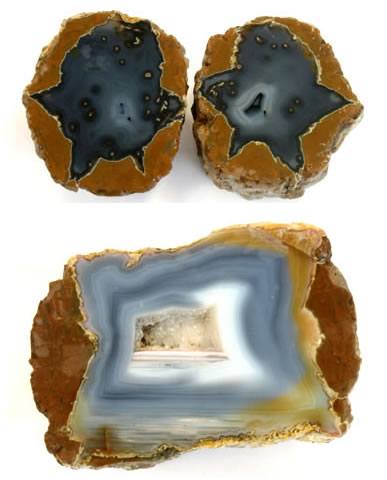
Oregon Thundereggs: Examples of thundereggs sawn to display their interior. The peak two are halves of a single egg about 3 inches in diameter. Information technology is filled with gray chalcedony with greyness agate and drusy quartz in the center. The bottom is a half egg nigh six inches in bore with gray banded agate around the outside, white agate towards the center, and a drusy quartz crenel in the heart. Acquire more most Oregon gemstones here.
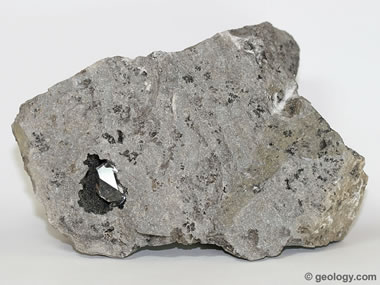
Herkimer diamond in a vug: A vug is an unlined cavity that will non remain when the stone that contains it weathers away. The famous doubly-terminated quartz crystals known as "Herkimer Diamonds" occur within vugs in the Footling Falls Dolostone of Herkimer County, New York. The rock in the photo is almost 18 centimeters across.
Geodes, Nodules, Vugs, Concretions and Thundereggs
Geodes, nodules, vugs, concretions and thundereggs are all sites in the earth where substances dissolved in subsurface waters precipitate to class crystals or rounded objects. These objects share many mutual features and class by similar processes. They all also produce objects that attract attention and stimulate debate. These objects are often dislocated with one another, and their names are used incorrectly because the speaker misunderstands the words or interprets the object incorrectly. They are also used in unlike ways by different people in diverse parts of the earth. Who is correct and who is wrong? Some generalizations fatigued from the common usage of these words are offered below...
- Geodes have a hollow space inside, or once had a hollow infinite inside that was filled with precipitated mineral textile. The precipitated mineral materials filled the crenel mainly through concentric inwards growth. They accept a competent external lining that allows them to separate from their host stone. This competent external lining allows many geodes to split up and survive after the host stone has been completely disintegrated by weathering. The geodes tin can then be collected from the country surface, dug from the soil, or found in stream beds.
- Nodules are solid objects equanimous of precipitated mineral material. They may have been hollow (and a geode) at one time, and then completely filled with precipitated mineral textile. They might also accept formed past mineral growth on a sediment surface, growth inside a cavity, or past replacement of their host rock.
- Vugs are cavities that might contain crystals, but they practise not have a competent lining that allows them to separate from their host rock. Unlike many geodes, they probably will not exist after the host rock is weathered away.
- Concretions are solid aggregates equanimous of sediment grains and a cementing material. They form when chemical precipitation begins around a nucleus in the sediment, such equally a fossil or a mineral grain. More and more material accumulates effectually the nucleus, and the concretion grows in three dimensions by filling in pore spaces and/or replacing mineral grains. Their growth starts in the middle and they enlarge outwards without a crenel, whereas geode growth begins in a cavity and the minerals grow inward.
- Thundereggs are spherical to subspherical masses of rhyolite that weather out of volcanic strata. They take an internal cavity that has been infilled with agate, opal or other mineral material. Thundereggs rarely comprise mineral crystals growing into a void.
United States Geode Localities
A few areas in the United states are well-known for their geodes and geode-like objects. Geodes are so pop in a few states that they take achieved the status of "official state rock" or "official state gem." The Iowa State General Assembly designated the "quartz geode" every bit the official "state rock" in 1967. The Oregon Senate designated the Thunderegg as the official "state stone" in 1965. And, the Minnesota Legislature designated the Lake Superior agate as the official state gem in 1969. Some of the more than noteworthy localities are described below. At that place are many more, and a good place to read about some of them is in a volume titled Geodes: Nature's Treasures by Brad Fifty. Cross and June Culp Zeitner.
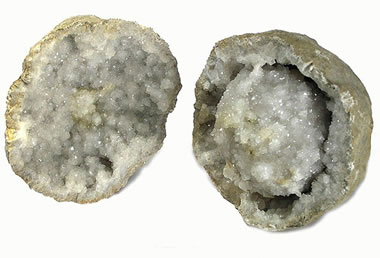
Keokuk geode from Lee County, Iowa. Specimen and photo by Arkenstone / world wide web.iRocks.com.
Keokuk Geodes
One of the best-known occurrences of geodes in the world is an area surrounding the community of Keokuk, Iowa. It is located near the three-state intersection of Illinois, Iowa and Missouri, with geodes of this locality being constitute in all three states. The geodes formed in the limestones and dolomites of the Mississippian-age Warsaw Formation. Most of these geodes are a few centimeters across and have outer layers of white to grey to blue-gray chalcedony with interiors lined by tiny quartz crystals. Most of the geodes found here have weathered free of their carbonate host rock and are now in the local soils and stream sediments. A few of these geodes contain interesting crystals of ankerite, aragonite, calcite, dolomite, goethite, gypsum, kaolinite, marcasite, millerite, pyrite, sphalerite and other minerals. A few have been found with liquid petroleum inside. [1] [2]
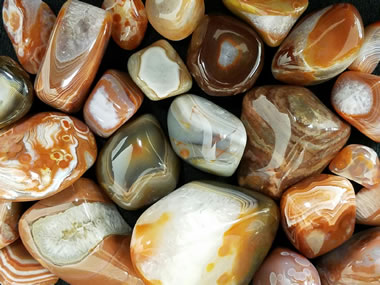
Lake Superior Agate: Some brightly polished tumbled stones made from Lake Superior agate nodules. They are commonly completely filled with agate and/or crystalline quartz. These tumbled stones show some squeamish agate banding and often a crystalline quartz core. Specimens and photo by RockTumbler.com.
Lake Superior Agate
The Lake Superior agate is a fortification agate that fills cavities in basalt flows that formed over a billion years ago in the Lake Superior region. Over time, silica-rich groundwaters filled these cavities with agate and crystalline quartz. Most of them have been completely infilled and are more properly called a "nodule." However, some still retain a cavity that is often lined with crystalline quartz. The agate within them is typically red dark-brown, red, and orangish blood-red in color. These colors are caused by trace amounts of iron that was incorporated in the agate. Today they are found along beaches, in stream channels, in the soil of farmers' fields and in glacial till. [three]
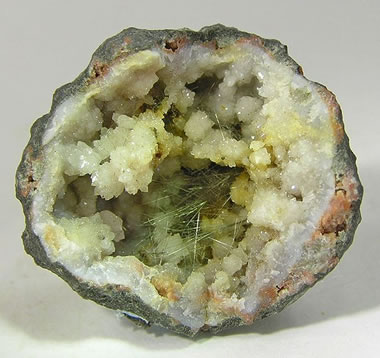
Kentucky geode with millerite. Specimen and photo by Arkenstone / world wide web.iRocks.com.
Geodes of Kentucky
Parts of the Fort Payne and Warsaw-Salem Formations of Kentucky contain large numbers of geodes. These have weathered out of their host rock units and are at present found in stream valleys. Other areas where numerous geodes are found in Kentucky stream valleys include the Green River in the south-central part of the state and along ancient terraces of the Kentucky River. [4]
Geodes of Wisconsin
The Geological and Natural History Survey of Wisconsin reports numerous occurrences of geodes, Lake Superior agate nodules, and thundereggs within the land. These take been in Ashland, Chippewa, Clark, Crawford, Douglas, Dunn, Grant, La Crosse, Milwaukee, Pepin, Pierce, St. Croix, Sheboygan, Trempealeau, and Washburn Counties. [5]
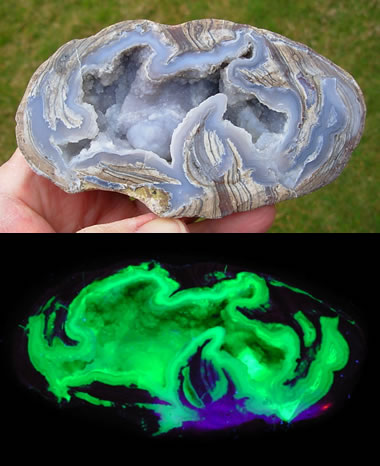
Fluorescent Dugway Geode: Many Dugway geodes contain fluorescent minerals and produce a spectacular display nether UV light! Specimen and photos by SpiritRock Shop.
Dugway Geodes
One of the most interesting geode deposits in the Us is in Juab County, Utah. Betwixt 32,000 and fourteen,000 years ago, Lake Bonneville covered much of what is now western Utah. Moving ridge action forth the shores of the lake eroded geode-bearing rhyolite flows. The wave action, forth with weathering, liberated the geodes from the rhyolite and deposited them several miles away in lake sediments of what is now known as the Dugway Geode Beds. [vi]
Today, lots of people search for Dugway geodes because they are thrilled to find their agate and crystal-lined centers. But, some of the Dugway Geodes contain some other subconscious surprise - trace amounts of uranium incorporated into their chalcedony lining cause the geode's interior lining to exhibit a spectacular lime-green fluorescence under ultraviolet calorie-free. [seven] Encounter accompanying image. They probably get lots of fluorescent mineral collectors interested in geode collecting.
| Geode Information |
| [one] Geodes: by Brian J. Witzke, a page on the website of the Iowa Geological Survey, accessed March 2017. [2] Geodes: Pocket-size Treasure Vaults in Illinois: a page on the website of the Illinois State Geological Survey, Prairie Research Constitute, accessed March 2017. [three] State Gem: The Lake Superior Agate, by Scott F. Wolter, Minnesota Department of Natural Resources, Fact Sheet Number 113, March 1988. [four] Geodes: a folio on the website of the Kentucky Geological Survey, University of Kentucky, accessed March 2017. [5] Quartz: a page on the website of the Wisconsin Geological and Natural History Survey, accessed March 2017. [vi] Dugway Geode Beds, Juab County: past Carl Ege, a page on the website of the Utah Geological Survey, accessed March 2017. [7] Dugway Geodes page on the SpiritRock Shop website, last accessed September 2021. [eight] Geodes: One of Nature's Mysteries: GEONotes #23, a publication of the Indiana Geological Survey, Indiana University, accessed March 2017. [9] The Gee!-Ode: What a weird hide, With such joy inside!: by Bob Jarrett, a page on the website of The Georgia Mineral Society, accessed March 2017. [10] Geologic Snowflake Hunters Flock To Oregon For Thundereggs: by Vince Patton, an article with video on the Oregon Public Broadcasting website, accessed March 2017. [11] Brazilian Elongated Amethyst Amygdules: by David Crosby, an article on the mindat.org website, accessed Apr 2018. [12] So Where Did That Amethyst Geode Come From? Article by Joe Wilhelm on the Touchstone Gallery weblog, accessed April 2018. [xiii] Amethyst Mining in Brazil: past David Stanley Epstein, Gems & Gemology, Winter 1988 issue, pages 214-228. [14] The Origin of Large Gypsum Crystals in the Geode of Pulpi (Almeria, Spain): past A. Canals, A.E.S. Van Driessche, F. Palero, and J.M. Garcia-Ruiz; Geology, Volume 47, October 2019. [15] The Mystery of the Behemothic Crystals: How the 36-Foot Geode of Pulpi Formed: past Hannah Osborne, an commodity posted on the Newsweek website, October 16, 2019. |
Geodes of Indiana
In south-key Indiana geodes can often be seen in exposures of the Harrodsburg Limestone and Ramp Creek Formations. The Indiana Geological Survey reports that geodes are abundant along streams and scattered on the ground for several miles on either side of their outcrop areas. [viii]
Woodbury Geodes
Woodbury geodes occur in the area effectually Woodbury, Tennessee. They originated in the limestones and dolostones of the Warsaw Germination and tin be seen where these stone units are outcropping. Liberated geodes are found in residuum soils above the rock units in which they formed, and in the sediments of the valleys that drain these areas. They are chalcedony-lined geodes with quartz crystal interiors. [9]
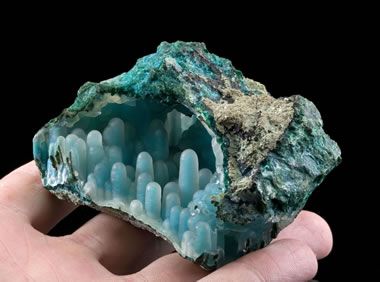
Stalactitic Gem Silica: A geode with stalactites of precious stone silica (inverted). From the Inspiration Mine, Gila Canton, Arizona. Specimen and photo by Arkenstone / www.iRocks.com. Learn more than nigh Arizona gemstones here.
Arizona Gem Silica Geodes
Some unusual geodes and nodules institute at the Inspiration Mine in Gila County, Arizona are lined with gem silica, a rare, beautiful and valuable course of blue chalcedony. Some take been found with gem silica stalactites!
Oregon Thundereggs
Thundereggs are not geodes, but they are so like that they deserve at least one locality mention in this commodity. The country of Oregon is the most famous thunderegg locality in the globe. Thundereggs are found in rhyolite and tuff deposits in many parts of the state. In 1965 the Oregon Legislative Associates issued a resolution making the thunderegg the official state rock. The state has a thunderegg museum and locations where you can enter, pay a small-scale fee, and look for thundereggs to take dwelling. [10]
Other Famous Geode Localities
There are hundreds of areas around the globe where geodes of various types can be found in affluence. Virtually of these deposits are small and support the collecting activities of a few rockhounds. However, other deposits are extensive, with plenty geodes to support a commercial drove and manufacturing industry.
Oco (Ocho) Geodes
Oco or Ocho geodes are small agate geodes with a drusy quartz lining that are found in the Tres Pinheiros region of Brazil. They range in size between about 1/ii and 3 inches in bore and formed in the vesicles of basalt flows that underlie parts of this region. Most Oco geodes accept a thin agate rind, an open interior, and an interior druse of tiny sharp quartz points nearly 1/8 inch long. Upon weathering, the basalt flow forms a reddish-brown soil and the geodes, being much more resistant to weathering than the basalt, accrue in the soil.
When the deposits were starting time exploited, the geodes were easy to detect and became a local business for people who nerveless and sold them. Many Oco geodes are sawn in one-half and polished, or are cut into slices and polished. These are sold in rock shops and novelty stores to people who enjoy interesting rocks and crystals. Because many Ocos take a very thin rind, they are ofttimes packaged and sold as "break a geode" kits. These are a popular action for elementary students who are learning about minerals and crystals in a science class.
Amethyst Amygdules of Brazil and Uruguay
Without question, the most spectacular geode deposit ever discovered is the amethyst amygdule basalts of Rio Grande practice Sul region of Brazil and adjacent Uruguay. About 160 one thousand thousand years agone, when plate tectonic processes were rifting Africa and South America apart as the Atlantic Sea opened, ane of the globe's great flood basalt events was occurring. Basalts flowed from the rift, producing stratified lava flows thousands of anxiety thick.
Within these flows, gas bubbles and lava tubes created cavities that were first lined by a layer of agate, and and then by a consummate covering of coarse crystalline quartz. At this indicate the geodes were formed, but they were filled with stone crystal instead of amethyst. Notwithstanding, as these geodes remained cached, they were irradiated past the decay of radioactive minerals in the surrounding basalts. This radiation created color centers in the quartz, and that transformed the clear quartz into amethyst. The resulting geodes are cute and some are enormous. Today they are carefully mined, sawn and made into display pieces that serve as gemmy decor in homes, offices and museums. [xi]
Some amethyst geodes are heated in a high temperature oven. This treatment causes the iron that is responsible for their purple color to oxidize. The event is a color transformation from amethyst quartz to citrine quartz.
The World's Largest Geode?
Geology.com has numerous articles about Earth Science World Records. These feature the world'southward tallest tsunami, world's largest volcano, world'southward tallest geyser and more. We accept learned from these articles that picking the largest, tallest, deepest, etc. will be met with disagreements nearly measurement methods, qualifying criteria, and more.
Like issues surround naming "the world's largest geode". The definition of a geode, the methods of measuring, the reliability of reports about large geodes - and more than - make choosing the "largest" problematic. So, nosotros are going to point to a geode that nosotros recall meets the definition and that is quite impressive in size. Some researchers have called it "the globe's largest geode", and others disagree, but virtually can concord that this is a actually big one.
The "Geode of Pulpi" is located about Almeria, Spain. It has a volume of approximately 11 cubic meters and a width of about 12 meters. Information technology is hosted in Triassic dolostone, and it has a discontinuous mineral sequence that begins with fe-carbonates and barite, followed past celestine, and final with an internal cavity into which giant gypsum (selenite) crystals protrude. The gypsum crystals are colorless and transparent and are said to "look similar blocks of ice". The geode was discovered in 1999 when information technology was intersected by a passage of the Mina Rica silvery mine. [14] [xv]
Notice Other Topics on Geology.com:
 Rocks: Galleries of igneous, sedimentary and metamorphic rock photos with descriptions. |  Minerals: Information about ore minerals, jewel materials and rock-forming minerals. |
 Volcanoes: Articles virtually volcanoes, volcanic hazards and eruptions past and present. |  Gemstones: Colorful images and manufactures near diamonds and colored stones. |
 Full general Geology: Manufactures about geysers, maars, deltas, rifts, salt domes, h2o, and much more! |  Geology Store: Hammers, field numberless, hand lenses, maps, books, hardness picks, gilded pans. |
 |  Diamonds: Learn nigh the properties of diamond, its many uses, and diamond discoveries. |
Source: https://geology.com/articles/geodes/
0 Response to "Baby Blue Gray Outer Gemstone Baby Blue Gray Outer Geode"
Post a Comment